
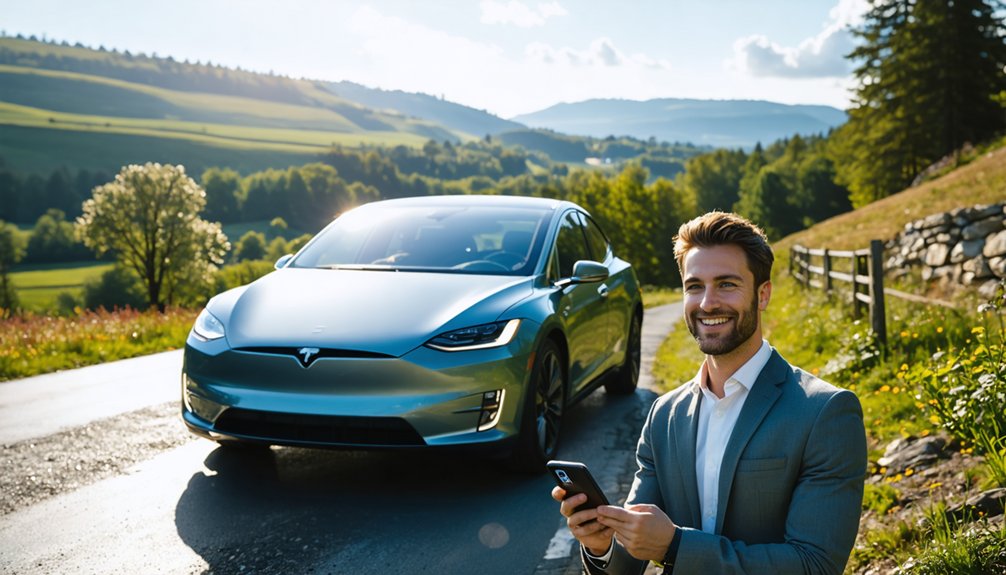

To determine if an electric vehicle (EV) suits an individual’s driving style, one must assess driving habits and patterns. Aggressive drivers may use more energy with rapid acceleration, while smooth drivers enhance efficiency. Real-world EV range often falls short of manufacturer claims, influenced by terrain and conditions. Additionally, maintenance practices and battery health affect performance. By understanding these factors, consumers can make informed decisions about EV suitability before choosing a model that aligns with their unique needs. More perspectives await.
Highlights
- Assess your acceleration habits; smooth driving enhances EV efficiency while aggressive driving can significantly reduce range and battery life.
- Consider your typical driving conditions; urban stop-and-go traffic and hilly terrains can impact energy consumption and overall performance of an EV.
- Evaluate the charging infrastructure in your area; accessible charging options are essential for convenient EV ownership, especially in rural areas.
- Understand your range needs based on your driving patterns; real-world range is often lower than manufacturer claims, so plan accordingly.
- Reflect on your maintenance willingness; EVs require specific care to maintain battery health and performance, impacting long-term reliability.
Understanding Your Driving Style
Understanding one’s driving style is often essential for determining whether an electric vehicle (EV) is a suitable choice. Driving habits, ranging from aggressive maneuvers to more relaxed approaches, reveal much about personal preferences. Statistical categorizations, such as aggressive versus normal driving, rely on key features like speed and throttle opening. Aggressive drivers, for instance, exhibit higher speeds and variable throttle use, while careful drivers demonstrate consistent, moderate behavior. Personality traits also influence these styles; conscientiousness correlates with safer driving. By evaluating driving patterns and evaluating psychological traits, potential EV owners can better align their choice with their unique driving habits. This understanding promotes a sense of belonging within the developing community of environmentally conscious drivers. Additionally, maladaptive driving styles such as reckless and careless driving are positively associated with an increased risk of accidents, which potential EV owners should consider when evaluating their driving style. Recent research indicated that user environment and activity data can be effectively utilized to predict driving style, offering further insights for prospective drivers. Moreover, understanding the acceptance of active driving guidance can enhance drivers’ experiences with EVs by tailoring features to their specific driving behaviors.
The Impact of Acceleration on Energy Consumption
While contemplating electric vehicle (EV) selection, one crucial factor to weigh is how acceleration patterns can substantially impact energy consumption. Electric acceleration, particularly through rapid bursts, leads to higher energy draw from the battery, decreasing overall vehicle efficiency. For sustainable driving, adopting a smooth and steady acceleration technique is beneficial; it reduces energy consumption and prolongs battery life. Convex acceleration curves can exacerbate energy use, while moderate driving habits optimize efficiency. In contrast, aggressive acceleration negatively affects driving range, draining power faster. Understanding the relationship between energy consumption and power battery life is essential for optimizing electric vehicle design. Additionally, electric vehicle efficiency is typically measured in kilowatt-hours per hundred kilometers (kWh/100 km), which underscores the importance of managing driving habits effectively. The impact of driving habits becomes even more significant considering that all-electric vehicles are recognized as zero-emission vehicles.
Real-World EV Range vs. Manufacturer Claims
When evaluating the practicality of an electric vehicle’s range, it is essential to take into account the distinction between manufacturer claims and real-world performance. While manufacturers may advertise ranges derived from lab tests, these figures often do not reflect actual driving conditions. Range variability due to factors such as weather and terrain typically results in a 10-20% reduction in usable range. Some models, like the LuxoStream EV, can fall short by over 20% in real-world scenarios. In contrast, brands like Hyundai and Kia exhibit greater manufacturer transparency, often presenting conservative estimates that align closely with reality. Understanding these discrepancies helps consumers set realistic expectations and guarantees a more satisfying ownership experience, especially considering that WLTP standardises the test across the globe for more comprehensive results. Moreover, the average EV achieves only around 85 percent of its label value in highway range tests, further emphasizing the importance of recognizing the limitations of advertised figures.
Importance of Terrain and Driving Conditions
Evaluating the range of an electric vehicle requires consideration not only of the vehicle’s specifications but also of the surrounding terrain and driving conditions. Terrain awareness is vital; hilly landscapes demand more energy, reducing range, while descents can utilize regenerative braking to recover some of that loss. Rough surfaces increase rolling resistance, further affecting energy efficiency. Additionally, temperature plays a significant role, as extreme cold can reduce range by up to 46%. To illustrate, WLTP figures typically overestimate real-world range by about 20-30%, highlighting the importance of considering actual driving conditions. Urban stop-and-go driving cycles, high-speed highway travel, and extra payload can all boost energy demand. Battery thermal management systems are essential in maintaining battery performance, especially in extreme temperatures. To maximize efficiency, drivers should plan routes mindful of terrain types, driving conditions, and weather impacts, nurturing a stronger connection with their EV choice and enhancing overall performance to navigate the scenery.
Evaluating Battery Health and Maintenance
Battery health is essential for ensuring the longevity and performance of electric vehicles (EVs).
Effective battery maintenance hinges on several key practices.
Adopting ideal charging habits, such as avoiding full charges and keeping the state of charge between 20% and 80%, helps mitigate battery degradation.
Regular use of Level 2 charging over DC fast charging can minimize chemical wear.
Additionally, monitoring battery temperature and utilizing advanced cooling systems improves durability.
It’s essential to perform routine checks as recommended by the manufacturer to maintain efficiency.
Analyzing Driving Patterns for Fleet Use
As companies increasingly consider electric vehicles (EVs) for their fleets, analyzing driving patterns becomes essential for determining suitability.
Fleet analysis should focus on metrics such as hard acceleration, harsh braking, and excessive idling, as they reveal driving intensity and style.
High instances of aggressive driving can diminish EV range, particularly in stop-and-go scenarios.
Identifying route characteristics is equally critical; routes with frequent stops may increase energy consumption, necessitating more frequent charging.
Implementing driver profiling through data collection techniques like telematics can help optimize operations and enhance battery efficiency.
Transitioning to an EV: Key Considerations
Shifting to an electric vehicle (EV) involves a careful analysis of several critical factors that can influence both immediate and long-term success. Tax incentives, such as federal credits ranging from $2,500 to $7,500, play a crucial role in stimulating consumer adoption. Recently, government policies under the Inflation Reduction Act expanded these incentives, appealing to a broader range of vehicles.
Urban regions with resilient charging infrastructure see higher EV adoption rates, while rural areas lag due to challenges in accessibility and affordability. Planners must also anticipate energy demand to guarantee sustainable growth during this shift. Ultimately, understanding individual driving patterns and infrastructure availability is essential for consumers considering an EV as part of a cohesive community-focused shift to sustainable transportation, and planners must guarantee that these elements are in place to facilitate a successful switch, where tax incentives play a crucial part.
Conclusion
In essence, determining if an electric vehicle (EV) suits one’s driving style requires careful consideration of various factors, including acceleration habits, real-world range, terrain, and maintenance needs. By evaluating individual driving patterns and conditions, potential EV owners can make informed decisions. Switching to an EV presents an opportunity for eco-conscious driving, but understanding personal driving preferences is vital for ensuring a seamless shift to electric mobility and maximizing the benefits of an EV.
References
- https://pmc.ncbi.nlm.nih.gov/articles/PMC9231560/
- https://clearwatt.co.uk/blog/what-is-the-real-world-range-for-electric-vehicles-battery-health-efficiency-and-data-insights
- https://www.edmunds.com/car-news/electric-car-range-and-consumption-epa-vs-edmunds.html
- https://www.geotab.com/uk/blog/real-world-data-for-fleet-electrification/
- https://deepblue.lib.umich.edu/bitstream/handle/2027.42/166283/itr2bf00581.pdf?sequence=1
- https://pmc.ncbi.nlm.nih.gov/articles/PMC6126823/
- https://www.hfes-europe.org/wp-content/uploads/2017/10/Moertl2017.pdf
- https://pmc.ncbi.nlm.nih.gov/articles/PMC5677450/
- https://www.nature.com/articles/s41598-025-03352-6
- https://www.nature.com/articles/s41598-023-50419-3