
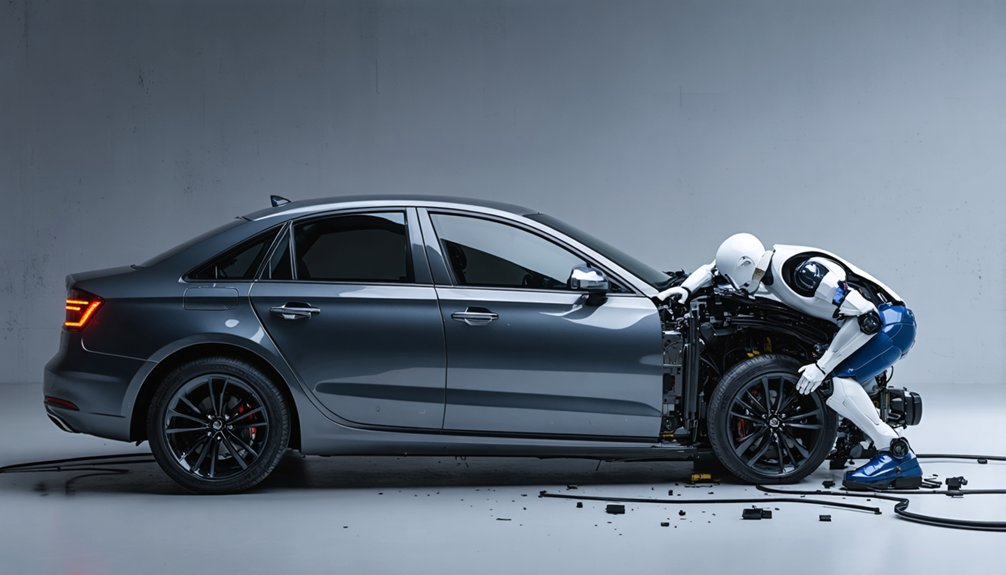

Safety ratings are critical evaluations that indicate a vehicle’s crashworthiness and ability to protect occupants. Organizations like NHTSA, IIHS, and Euro NCAP assess various tests, including frontal, side, and rollover impacts, resulting in star ratings. Higher ratings suggest better safety performance, influencing consumer decisions. Factors like driver behavior and external conditions also play significant roles in real-world safety outcomes. Understanding these ratings can enable consumers to make informed choices about vehicle safety in their purchases.
Highlights
- Safety ratings, like those from NHTSA and IIHS, provide critical insights into a vehicle’s crashworthiness and safety features.
- A five-star rating indicates superior safety performance, while lower scores highlight potential risks during collisions.
- Euro NCAP evaluates adult and child occupant protection, pedestrian safety, and safety assist features, reflecting a car’s overall safety.
- Regular updates to safety ratings ensure they keep pace with evolving vehicle technologies and safety standards.
- Understanding safety ratings helps consumers make informed decisions, guiding them towards safer vehicle choices for their needs.
Understanding Safety Rating Systems
Although safety ratings can often seem complex, they serve a crucial role in helping consumers make informed decisions regarding vehicle purchases.
In the U.S., two prominent organizations—NHTSA and IIHS—provide these essential evaluations. NHTSA employs a 5-star scale, rigorously evaluating crash tests, including frontal, side, and rollover scenarios primarily focused on crashworthiness. Conversely, IIHS combines qualitative ratings—Poor, Marginal, Acceptable, and Good—to evaluate not only crash tests but also critical safety features, such as automatic braking capabilities. Euro NCAP has created a five-star safety rating system, similar to NHTSA’s approach, to help consumers in Europe compare vehicles more easily.
Additionally, vehicles are rated on their performance in child safety to ensure proper provisions for young occupants, emphasizing the importance of comprehensive evaluations. The near-simultaneous advancements in crash test methodologies and safety technology promise that these ratings continue to reflect true occupant protection and accident prevention. Understanding these systems enables consumers to prioritize safety in their vehicle choices effectively. Moreover, considering factors like average monthly car payments can help buyers make more informed decisions about which safe vehicles fit their budget.
Euro NCAP Ratings Explained
Euro NCAP provides a thorough assessment of vehicle safety, standing as a benchmark in automotive safety ratings across Europe. The evaluation encompasses several key categories, including adult occupant protection, child occupant protection, pedestrian safety, and safety assist features. Through rigorous crash tests that simulate real-world collisions, Euro NCAP assesses vehicle performance regarding structural integrity and injury risk. Additionally, it evaluates the effectiveness of safety features such as automatic emergency braking and lane monitoring systems. Ratings are reflective of composite scores in these categories, updated regularly to incorporate advancements in safety technology. Euro NCAP ratings serve as an independent testbed for new cars on the market, ensuring consumers have access to reliable safety information. The safety rating is out of 5 stars, with a five-star rating indicating top-tier safety, thereby promoting a community interest in enhanced vehicular safety across the market. This commitment to safety has helped save upwards of 78,000 lives in Europe since Euro NCAP’s inception.
NHTSA Rating Details
The NHTSA (National Highway Traffic Safety Administration) rating system offers a critical structure for evaluating vehicle safety in the United States, utilizing a 5-star scale where higher ratings indicate better safety performance.
This system assesses vehicles through frontal crash, side crash, and rollover tests, producing an Overall Vehicle Score that reflects overall injury risk. Particularly, frontal crash ratings are confined to similar vehicle classes, while side and rollover results are universally applicable. Consumers are encouraged to weigh the ⚠ symbol on rating displays, which highlights government-identified safety concerns unrelated to star ratings. Safety ratings are determined by organizations such as the IIHS and NHTSA, which continuously redefine safety standards through evolving crash tests. Notably, NHTSA conducts 90 to 125 tests annually on high-volume models to ensure thorough evaluations.
Regular updates to the NHTSA program guarantee that vehicle safety evolves in line with technological advancements, advocating for enhanced occupant protection and crash avoidance features essential for informed consumer choices.
IIHS Safety Ratings Overview
As vehicle safety standards continue to evolve alongside advancements in automotive technology, the IIHS (Insurance Institute for Highway Safety) plays a vital role in evaluating and communicating safety performance.
The IIHS testing structure encompasses various crashworthiness metrics, including a range of individual tests that assess structural integrity and occupant protection. Particularly, categories such as small overlap front, moderate overlap front, and side crash tests are thoroughly analyzed to guarantee exhaustive safety evaluations. This rigorous testing process has resulted in numerous Mazda vehicles receiving prestigious accolades like the IIHS TOP SAFETY PICK + award. Moreover, the 2022 update in moderate overlap testing introduced a second crash test dummy seated behind the driver, further enhancing the evaluation process.
The Institute also emphasizes critical safety features, like front crash prevention systems and headlight performance, which are essential for preventing accidents. Their stringent ratings—Good, Acceptable, Marginal, and Poor—not only guide consumers in making informed choices but also encourage manufacturers to enhance vehicle safety across the board.
Common Crash Test Types
Crash test types serve as critical benchmarks in evaluating vehicle safety, focusing on various collision scenarios to evaluate occupant protection and structural integrity.
Frontal impact tests, including full-frontal and small overlap tests, analyze how well vehicles absorb energy and shield occupants during collisions.
Side impact tests replicate T-bone accidents to assess the risk of injury to the thorax and pelvis, while rollover tests evaluate a vehicle’s stability and roof strength to protect passengers during rollovers.
In addition, safety-equipment tests scrutinize child restraint systems and driver-assistance technologies, ensuring compliance with safety standards.
Together, these crash analysis methods contribute substantially to vehicle inspection, enhancing understanding and strategies for improving overall safety across the automotive industry.
What Ratings Imply for Consumers
Understanding safety ratings is essential for consumers seeking reliable vehicles, especially when considering the implications for occupant protection and overall safety.
Vehicle safety ratings, ranging from 0 to 5 stars, offer vital information into a car’s crashworthiness and the presence of advanced driver assistance technologies.
Higher ratings suggest better protection, influencing consumer awareness and purchasing decisions.
For example, a 5-star rated vehicle not only minimizes injuries but may also positively affect insurance premiums and resale values.
Conversely, lower-rated vehicles pose greater risks, typically lacking modern safety features.
Consumers should prioritize these ratings while considering their specific needs, thereby promoting an informed community that values safety in transport.
Ultimately, understanding ratings promotes better decision-making for responsible vehicle ownership, gaining key perspectives into a car’s safety.
The Role of Driver Behavior and Conditions
Consumer awareness of safety ratings is vital, but the role of driver behavior and external conditions is equally significant in determining road safety outcomes.
Risk-y driving behaviors such as speeding, hard braking, and aggressive maneuvers markedly boost crash risks, making driver behavior a critical component of vehicle safety.
Moreover, road conditions—such as weather and terrain—interact with these behaviors, influencing their impact on safety.
For instance, novice drivers face higher crash risks regardless of their vehicle’s safety rating, highlighting the importance of experience.
Additionally, demographic factors can alter crash outcomes, with gender differences affecting injury severity.
Ultimately, while vehicle safety ratings provide essential perspectives, driver behavior and changing road conditions substantially shape real-world safety experiences.
Conclusion
In essence, safety ratings serve as a vital benchmark for evaluating vehicle performance in crash scenarios. Understanding the subtleties of different rating systems, such as Euro NCAP, NHTSA, and IIHS, enables consumers to make informed decisions. However, it is essential to recognize that these ratings are shaped by specific testing parameters and do not account for all real-world driving conditions. Ultimately, a vehicle’s safety is a combination of its ratings and the driver’s behavior in various situations.
References
- https://www.euroncap.com/en/about-euro-ncap/how-to-read-the-stars/
- https://www.hondasouth.com/blog/2023/july/26/car-safety-ratings-explained-what-you-need-to-know.htm
- https://www.awjlaw.com/faqs/vehicles-5-star-safety-ratings-explained/
- https://www.kbb.com/car-advice/car-safety-ratings-guide/
- https://www.nhtsa.gov/ratings
- https://www.chase.com/personal/auto/education/buying/car-safety-ratings
- https://www.carwow.co.uk/guides/choosing/euro-ncap-scores-explained
- https://en.wikipedia.org/wiki/Euro_NCAP
- https://www.emgmotorgroup.com/news/euro-ncap-explained
- https://www.euroncap.com/en/car-safety/the-ratings-explained/